If you are planning to buy in the Greater Toronto Area (GTA), you may be wondering whether to buy a home now or wait until 2027. Prices have adjusted from earlier peaks, mortgage costs remain an important concern, and conditions vary widely between neighbourhoods and property types.
There is no single answer for every buyer. The right decision depends on what you can afford today, how stable your finances are, what you want to buy, and how long you plan to own it. Waiting may improve your position, but it could also mean higher prices, more competition, or another year of rent.
This guide explains how to decide when to buy a home in the GTA without depending on a perfect market forecast.
Start With the Big Question: Buy Now or Wait?
Before comparing 2026 with 2027, consider the factors that will directly affect your purchase:
- The price of suitable homes in your preferred area
- The mortgage payment you can comfortably carry
- Your down payment, closing funds, and emergency savings
- Your job and income stability
- Available inventory
- How long you expect to own the property
These are the most useful factors to consider before buying a home in the GTA because they focus on your real options rather than a regional headline. If you are still comparing ownership with the flexibility of renting, our guide to renting vs. buying a house can help you assess both paths.
Timing the exact bottom of a real estate cycle is extremely difficult. A sound purchase does not require the lowest possible price. It requires a suitable property, manageable costs, and enough time for ownership to support your goals.
What Is Happening in the GTA Market in 2026?
The GTA entered the fall of 2026 with lower prices than a year earlier but also with fewer new listings.
- According to the Toronto Regional Real Estate Board (TRREB), 5,057 homes sold through its Multiple Listing Service (MLS) system in August 2026, down 2.1% from August 2025.
- New listings fell more sharply by 14.1% to 12,075. The average selling price was $993,410, down 2.7%, while the MLS Home Price Index (MLS HPI) composite benchmark declined 4.5%.
However, the benchmark was essentially unchanged from July on a seasonally adjusted basis. The figures are available in TRREB’s August 2026 Market Watch.
So, is the GTA a buyer’s market in 2026? Buyers have more negotiating room in many areas than they did during highly competitive periods, but the market is not uniform. A well-priced house in a sought-after school district may still attract strong interest, while a condominium in a building with several similar listings may face less competition.
Our analysis of whether house prices are falling in Toronto provides more context on why results depend on the location, property type, and period being measured.
For additional insight into changing sales, inventory, and pricing conditions, review our latest GTA real estate market update.
Could Prices Be Better in 2027?
Buyers wondering if GTA home prices will go down in 2027 are usually hoping that waiting will provide a lower entry price. That could happen if demand weakens or listings increase faster than sales, but it is not guaranteed.
Prices could also stabilize or rise if borrowing conditions improve and more buyers return while inventory remains limited. In that situation, part of the benefit of lower mortgage rates could be offset by higher prices or stronger competition.
The same uncertainty applies when considering whether Toronto home prices will increase in 2027. Instead of relying on one prediction, prepare for three reasonable possibilities: prices fall, remain relatively stable, or begin rising. Your purchase should remain affordable under more than one outcome.
Mortgage Rates: Buy Now vs. Wait
On September 2, 2026, the Bank of Canada held its policy interest rate at 2.25% and noted continued uncertainty around economic growth and inflation.
The policy rate influences variable mortgage rates, but it is not the same as the rate offered on every mortgage. Fixed rates are also affected by bond yields, lender costs, competition, and the borrower’s application. Therefore, deciding whether it is better to buy now or wait for lower mortgage rates requires more than predicting the Bank of Canada’s next decision.
For uninsured mortgages, the Office of the Superintendent of Financial Institutions (OSFI) states that borrowers generally qualify at the greater of the contract rate plus 2% or 5.25% under the current minimum qualifying rate. Before setting your purchase budget, understand the difference between mortgage pre-approval and pre-qualification. A pre-approval can provide a more useful estimate, but it remains subject to conditions and is not a final mortgage approval.
It is possible that some mortgage rates will be lower in 2027 in Canada, but buyers should not depend on that result. The Bank of Canada’s July 2026 Monetary Policy Report projected stronger growth in 2027 while emphasizing continued economic uncertainty. A purchase should work with the financing available when you make the offer.
The Cost of Waiting
Waiting may be the right choice, but it is not free. The cost can include another year of rent, a higher future price, a larger required down payment, and less selection if inventory tightens.
Consider a simplified example. A $900,000 home purchased with a 20% down payment would require a $720,000 mortgage. At an illustrative fixed rate of 4.5% over a 25-year amortization, the monthly principal-and-interest payment would be about $3,985.
If the buyer waits and the rate falls to 4%, but the price rises by 3% to $927,000, a 20% down payment would leave a $741,600 mortgage. The payment would be about $3,901. The lower rate still helps, but the monthly difference is only about $84, and the buyer needs an additional $5,400 for the down payment. This example excludes taxes, insurance, maintenance, utilities, and closing costs, and it is not a forecast.
This is why deciding whether to buy now or wait for home prices to fall means looking at both the purchase price and the cost of financing.
Why Buying Now May Make Sense
Buying in 2026 may be reasonable if:
- Your income is stable, and your debt is manageable
- You have enough for the down payment, closing costs, and an emergency fund
- The payment works without relying on a future rate cut
- You expect to keep the property for several years
- A suitable home is available in your preferred area
Some house buyers may also benefit from greater negotiating room or the ability to include appropriate financing, inspection, or condominium-document conditions. Those opportunities could narrow if demand strengthens.
If the purchase is primarily an investment, use a separate analysis of cash flow, financing, and risk. We explain the main considerations in our guide on how to invest in real estate.
Why Waiting Until 2027 May Make Sense
Waiting can be the stronger decision when it materially improves your position. It may make sense if:
- Your income or employment is uncertain
- Buying would use nearly all your available cash
- You need time to reduce debt or improve your credit
- Your expected ownership period is short
- You have not decided where or what to buy
- You must sell another property first
If your purchase depends on another transaction, planning the home selling timeline early can reduce financing and closing risk.
Give the waiting period a clear purpose. Set a savings, debt-reduction, or affordability target and review it regularly. Simply waiting to see what the market does does not improve your position unless your own circumstances also change.
Do Not Focus Only on the GTA Average
The GTA average combines very different markets. Toronto condominiums, Durham townhomes, Mississauga semi-detached homes, and York Region detached properties do not move together.
When assessing what the GTA housing market could look like in 2027, narrow the analysis to the municipality, neighbourhood, property type, and price range. Review recent comparable sales, active listings, days on market, and sale-to-list price patterns.
A regional decline does not mean every suitable home will become cheaper. Likewise, an increase in the GTA average does not mean every property has gained the same amount.
Condo vs. Detached: Different Buying Decisions
The choice between a condominium and a detached home may matter more than buying a few months earlier or later.
Condominiums often have a lower entry price, but buyers must review monthly fees, the status certificate, reserve-fund information, and planned major work. Detached homes may provide more space and land, but they usually require a larger budget and direct responsibility for maintenance.
Our comparison of a condo versus a freehold home covers the ownership and cost differences in more detail. Buyers considering pre-construction properties should also assess deposit schedules, occupancy costs, closing adjustments, and future financing requirements.
Consider Your Time Horizon
Buying and selling involve land transfer taxes, legal fees, moving expenses, possible mortgage penalties, and selling costs. These expenses can make a short ownership period risky even if the property increases modestly in value.
A longer time horizon gives you more opportunity to move through normal market changes and reduce the mortgage principal. If you expect a job relocation, household change, or another move soon, renting may preserve useful flexibility.
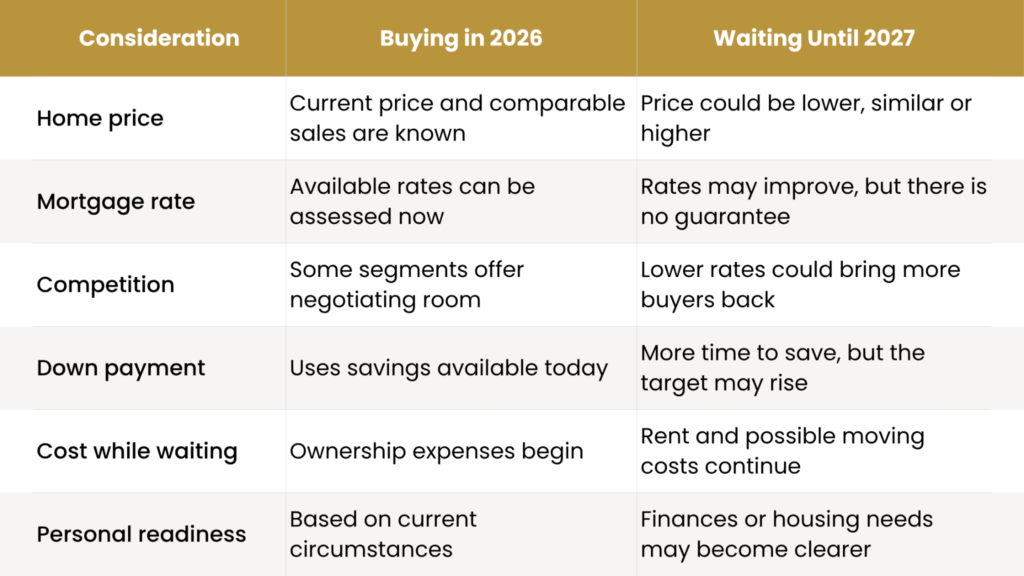
2026 vs. 2027 Comparison
The comparison below is not a forecast that favours one year. It shows which variables are known and which remain uncertain.
A Practical Decision Framework
Ask these questions before deciding:
- Is the full monthly cost comfortable? Include the mortgage, property taxes, utilities, insurance, maintenance, and condominium fees where applicable.
- Will you have cash left after closing? Keep funds for immediate expenses and emergencies.
- Does the property fit your longer-term plans? Consider work, family, commuting, and space needs.
- What would improve by waiting? Identify a specific savings, debt, or affordability target.
- What do local comparable sales show? Use evidence from the property type and neighbourhood, not only GTA-wide statistics.
- Have you completed the buying groundwork? Our guide on how to buy a house in Canada explains the main stages from budgeting through closing.
Do Not Try to Predict the Exact Bottom
Whether you should wait until 2027 to buy a house depends on whether the extra time would meaningfully improve your financial position.
If you are financially prepared, have a long time horizon, and find the right property at a supportable price, buying in 2026 can make sense. If your budget is tight or another year would substantially strengthen your cash position, waiting may be prudent.
The goal is not to choose the perfect month. It is to make a purchase you can comfortably carry through changing prices and rates.
Make the Decision Based on Your Position
Choosing whether to buy in 2026 or wait until 2027 requires more than a price prediction. Review your financing, cash reserves, expected ownership period, and the conditions affecting the exact type of property you want.
At Big City Realty, we can help you compare current listings, recent sales, and realistic purchase scenarios across the GTA so you can move forward based on evidence rather than market noise.
Frequently Asked Questions
1. Is 2026 a Good Time to Buy a Home in the GTA?
It can be if your finances are stable, you have sufficient savings, and you plan to own the property for several years. Local conditions and monthly affordability should guide the decision.
2. Will GTA Home Prices Go Down in 2027?
Prices may decline in some areas or property categories, but a GTA-wide decrease is not certain. Inventory, employment, borrowing costs, and buyer confidence will influence the outcome.
3. Will Toronto Home Prices Increase in 2027?
Prices could rise if demand improves faster than supply. Other segments may remain stable or decline, so review recent sales for the specific neighbourhood and property type you are considering.
4. Is It Better to Buy Now or Wait for Lower Mortgage Rates?
A lower rate can reduce the payment, but waiting may also bring a higher price or more competition. Compare several combinations of price and rate rather than focusing on either factor alone.
5. Will Mortgage Rates Be Lower in 2027 in Canada?
They may be, but the outcome is uncertain. Build your plan around a payment you can afford now and treat a future rate reduction as a possible benefit, not a requirement.
6. What Will the GTA Housing Market Look Like in 2027?
Conditions will likely continue to vary by location, property type, and price range. Watch new listings, sales, days on market, comparable prices, and mortgage qualification conditions.