Buying a home in the Greater Toronto Area (GTA) often starts long before the first showing. It starts with understanding what you can reasonably afford and how confidently you can make an offer.
That is where mortgage pre-qualification and mortgage pre-approval come in. The terms sound similar, and some lenders use them interchangeably, but they may represent very different levels of financial review. A quick estimate based on information you provide is not the same as a lender examining your income, debts, down payment, and credit history.
Understanding mortgage pre-approval vs. pre-qualification can help you search within a realistic price range, prepare the right documents, and avoid treating an early estimate as guaranteed financing. It is especially useful in the GTA, where property taxes, condominium fees, and prices can differ significantly between neighbourhoods and property types.
This guide explains what each step usually involves, what a pre-approval can and cannot tell you, and how to prepare before making an offer.
Mortgage Pre-Approval vs. Pre-Qualification: What Is the Difference?
In general, pre-qualification is an early estimate of how much you may be able to borrow. It is often based on financial information you provide, such as your income, debts, and intended down payment. Depending on the provider, those details may not be fully verified at this stage.
A pre-approval usually involves a more detailed review. The lender or mortgage broker may request supporting documents, review your credit history, and assess your finances under the lender’s current guidelines. You may receive a maximum potential mortgage amount and, in some cases, an interest-rate hold.
However, there is no universal naming system across the Canadian mortgage market. The Financial Consumer Agency of Canada (FCAC) notes that the pre-approval process may also be called pre-qualification or pre-authorization and that lenders can define their own steps and criteria.
For that reason, the most useful question is not simply, “What is this document called?” Ask what the provider reviewed, whether your documents and credit were checked, whether a rate is being held, and what conditions remain.
What Is Mortgage Pre-Qualification?
Mortgage pre-qualification is typically an initial affordability estimate. You may provide details about your household income, monthly debt payments, available down payment, and expected housing costs. A lender, broker, or online tool then gives you a preliminary borrowing range.
The mortgage pre-qualification process may be useful when you are still deciding whether homeownership is realistic or comparing broad price ranges. It can help you answer early questions such as whether to focus on a condominium, townhouse, or freehold property. Our comparison of a condo versus freehold home can help you consider the ownership costs that sit beyond the listing price.
Pre-qualification has clear limits. If it relies mainly on unverified information, the result can change once the provider reviews your documents, credit obligations, and the property itself. An estimate may also overlook costs that affect your practical budget, such as
- Property taxes
- Heating and utilities
- Condominium maintenance fees
- Home insurance
- Closing and moving costs
- Repairs, maintenance, and an emergency reserve
Use pre-qualification as an orientation tool, not as permission to make an offer at the top of the estimated range.
If you are still comparing renting versus buying a house, pre-qualification can provide an initial estimate of whether purchasing fits your current budget.
What Is Mortgage Pre-Approval?
Getting pre-approved for a mortgage generally means completing a more detailed financial assessment. The provider may verify your identity, income, and employment; examine your existing obligations; review the source of your down payment; and obtain your consent to check your credit.
The result may state the maximum mortgage amount you could qualify for, an estimated payment, and a rate that may be held for a limited period. FCAC says a rate hold may last from 60 to 130 days, depending on the lender. Terms differ, so ask how long the rate is protected, whether you will receive a lower rate if rates fall, and whether the pre-approval can be extended.
A home loan pre-approval is stronger than a basic estimate when it is supported by documents and credit checks. It can make your property search more focused and help your real estate representative assess whether a potential purchase fits the financial plan you established.
Even a detailed pre-approval is conditional. Final mortgage approval still depends on updated borrower information, the property, and the lender’s requirements at the time of the application.
Pre-Approval vs. Pre-Qualification: Side-by-Side Comparison
Because providers define the terms differently, confirm the scope of the review in writing. The following table reflects the distinction buyers commonly encounter.
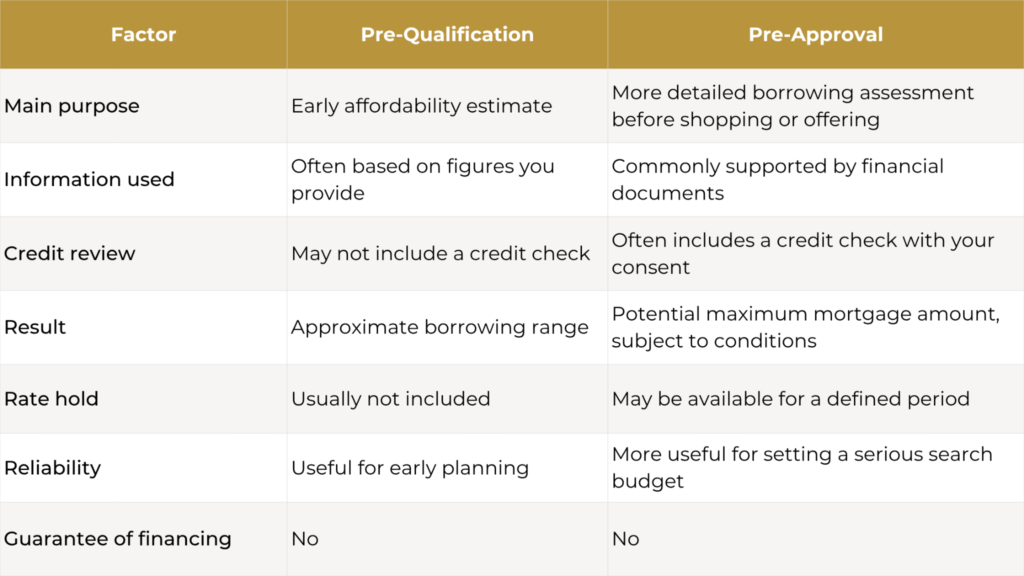
So, is mortgage pre-approval better than pre-qualification? It is generally more useful when you are preparing to search seriously or make an offer because it usually involves more verification. Pre-qualification can still be valuable earlier, when you want a quick starting point and are not ready to submit documents.
Why Pre-Approval Matters for GTA Homebuyers
A thoughtful mortgage pre-approval in the GTA helps turn a broad wish list into a practical property search. A buyer who knows the likely financing ceiling can compare locations and property types without relying only on asking prices.
It can also improve decision-making when the market changes. Follow a current GTA real estate market update to understand conditions, but base your purchase on your own budget rather than a prediction about the next rate or price movement. If you are debating whether to buy a home now or wait until 2027 in the GTA, a current pre-approval can show whether waiting would address a genuine affordability gap or simply delay a purchase you can already carry comfortably.
Pre-approval may also help you:
- Identify documentation problems before an offer deadline
- Understand how car loans, credit cards, or lines of credit affect borrowing capacity
- Compare the monthly cost of different property types
- Leave room for closing costs and post-purchase expenses
- Discuss financing conditions with your real estate representative and legal professional from a better-informed position
It should not encourage you to spend the maximum. FCAC specifically advises buyers to consider homes below the pre-approved amount so they do not stretch their budgets to the limit.
Buyers following whether house prices are falling in Toronto should still establish their borrowing range before reacting to short-term market changes.
How Much Can You Get Pre-Approved For?
There is no single income multiple that can accurately answer how much you can get pre-approved for a mortgage. Providers assess the full application under their own guidelines. Factors may include:
- Gross household income and its stability
- Existing debt payments and other financial obligations
- Credit history
- The size and source of the down payment
- Expected property taxes, heating costs, and condominium fees
- The interest rate used to qualify the application
- The requested amortization period
- The type, use, and value of the property
Consider a simplified example. Two GTA buyers earn the same household income and have the same down payment. One has a large monthly vehicle payment and revolving credit balances, while the other has little debt. They may receive different pre-approval amounts because the first household has less room for housing costs after its other obligations are considered.
The maximum mortgage amount is also not the same as the maximum safe purchase price. Your down payment contributes to the purchase price, while closing costs generally need to be funded separately. Your personal comfort level may be lower than the lender’s ceiling once you account for childcare, commuting, savings, travel, or other priorities.
Before setting your search range, review the complete process of how to buy a house in Canada so financing, property selection, conditions, and closing are treated as connected decisions.
What Documents Do You Need for Mortgage Pre-Approval?
Exact mortgage pre-approval requirements vary by provider and by employment type. Preparing the file in advance can reduce delays and reveal missing information before you find a property.
Common mortgage pre-approval documents may include:
- Government-issued identification
- A recent employment letter
- Recent pay stubs
- T4 slips and Notices of Assessment (NOA) from the Canada Revenue Agency (CRA)
- Additional income records, where applicable
- Bank or investment statements showing the down payment and closing funds
- Details of debts and monthly obligations
- Statements for loans, credit cards, and lines of credit
- Documents explaining gifted funds or another permitted down payment source
Self-employed applicants may need a more extensive record. FCAC notes that a lender or broker may request CRA NOA for the previous two years. Depending on the file, business financial statements, incorporation records, or other proof of earnings may also be requested.
Do not move large sums between accounts without keeping a clear paper trail. Providers may need to confirm where the funds came from and that they are available for the purchase.
Does Mortgage Pre-Approval Affect Your Credit Score?
Whether mortgage pre-approval affects your credit score depends on what the provider does. A detailed pre-approval will often include a credit check. A basic pre-qualification based on self-reported information may not.
Before giving consent, ask:
- Whether the provider will access your credit file
- What type of inquiry will be recorded
- Whether additional applications will create further inquiries
- When another credit check may be required
A credit check is only one part of the review. Avoid taking on new debt, financing a vehicle, increasing credit balances, or missing payments between pre-approval and closing. Any of these changes can affect the final assessment, even if your original pre-approval amount looked comfortable.
How Long Does Mortgage Pre-Approval Take?
There is no universal answer to how long mortgage pre-approval takes. A straightforward salaried application with complete documents may be reviewed relatively quickly, while self-employment income, multiple properties, variable earnings, gifted funds, or unresolved credit issues can require more time.
You can help the process move efficiently by providing complete, current, and legible documents, answering questions promptly, and disclosing debts and obligations accurately. A fast decision is not necessarily a thorough one, so confirm what was actually verified before relying on the result.
How Long Does Mortgage Pre-Approval Last?
The financial assessment and any rate hold have expiry dates. As noted above, FCAC says rate holds may range from 60 to 130 days, depending on the lender. Your provider should confirm the exact period and conditions.
If your home search continues beyond that window, the provider may need updated documents, a new credit check, or a fresh review under current rates and guidelines. A material change in income, employment, debt, or down payment can also require reassessment before the original expiry date.
Treat the date on your pre-approval as a review point, not as a guarantee that every part of the file will remain unchanged until closing.
Pre-Approval, Rate Holds, and Final Mortgage Approval
The most important distinction is between a pre-approval and approval for a specific property. How mortgage pre-approval works before you choose a home is different from final underwriting after you have an accepted agreement of purchase and sale.
At the final stage, the lender may review or reverify:
- Your income, employment, debts, and credit
- The down payment and closing funds
- The purchase agreement
- The property’s value and marketability
- The property type, condition, and intended use
- Whether all lender and mortgage insurer conditions are satisfied
A lender may decline the property even when the borrower was pre-approved. For example, the appraisal may not support the purchase price, or the building or property may fall outside the lender’s guidelines. FCAC confirms that a lender can refuse a mortgage after pre-approval and that final approval depends partly on the property meeting the lender’s standards.
A rate hold does not remove these conditions. It protects an eligible rate for a specified period under stated terms; it does not reserve funds for any property you choose.
This is why a financing condition can remain important even for a pre-approved buyer. The appropriate conditions depend on the property, market, and your circumstances, so review the offer strategy with your real estate representative, mortgage professional, and legal professional before signing.
Tips for First-Time GTA Homebuyers
For a first-time homebuyer in the GTA, the mortgage amount is only one part of the preparation. Use these steps to create a safer buying plan:
- Start with your monthly comfort level. Decide what payment leaves room for savings, maintenance, and the rest of your life before focusing on the maximum a lender may offer.
- Prepare documents early. Confirm that names, addresses, employment details, and account records are consistent and current.
- Protect your credit and cash flow. Avoid new financing and significant balance increases before closing.
- Budget for the full transaction. Include land transfer tax, legal fees, inspections, moving expenses, adjustments, and immediate repairs where applicable.
- Research available programs. Eligible buyers may benefit from federal, provincial, or municipal support. Review current first-time home buyer incentives in Ontario and confirm the rules with the relevant government authority or financial professional.
- Choose the property type carefully. A lower purchase price does not automatically mean lower total monthly costs, especially when condominium fees or substantial repairs are involved.
- Keep the pre-approval current. Tell your mortgage professional about changes to your employment, debts, income, or down payment before making an offer.
Our house buyers resource can help you organize the property-search side of the process once your financing range is clear.
When Should You Get Pre-Approved?
If you are wondering when to get pre-approved for a mortgage, a useful time is shortly before you expect to begin serious viewings. That gives you a current financial picture without using too much of a time-limited rate-hold period before you are ready to act.
Get pre-approved earlier if your income is variable, you are self-employed, your down payment is coming from several sources, or you are unsure how existing debt will affect the application. Extra time allows you to address documentation or affordability issues without the pressure of an accepted offer.
You may also need a new review if you pause your search, change jobs, take on debt, or shift from a resale purchase to a longer-term transaction. Buyers considering pre-construction properties should discuss financing timelines carefully because an early pre-approval or rate hold will not normally remain valid until a development is completed.
Get Pre-Approved Before Starting Your GTA Home Search
The practical difference between pre-approval and pre-qualification is the depth of review behind the result. Pre-qualification can provide an early estimate. A document-supported pre-approval can give you a stronger basis for setting a search budget and preparing an offer, but it still does not guarantee final financing.
Confirm exactly what your provider has reviewed, understand the remaining conditions, and choose a purchase price that works for your life rather than simply matching the maximum shown on a letter.
When you are ready to search, we can help you compare GTA properties within a realistic budget, understand how ownership costs differ, and build an offer strategy around your needs. Contact Big City Realty to plan your next step with greater clarity.
Frequently Asked Questions
1. What is the difference between mortgage pre-approval and pre-qualification?
Pre-qualification is usually an early estimate based on financial information you provide. Pre-approval commonly involves more detailed verification, supporting documents, and a credit review. However, Canadian providers may use the terms differently, so ask what was actually assessed.
2. Does mortgage pre-qualification guarantee approval?
No. Mortgage pre-qualification does not guarantee approval. It is generally a preliminary estimate and may change when your documents, credit, down payment, and chosen property are reviewed.
3. Does mortgage pre-approval guarantee a mortgage?
No. Mortgage pre-approval does not guarantee a mortgage. Final approval may depend on updated financial information, an appraisal, the property’s characteristics, the purchase agreement, and satisfaction of all lender or insurer conditions.
4. Can I buy a house without mortgage pre-approval?
You can make an offer without a pre-approval, but doing so can create avoidable uncertainty about your borrowing range and readiness. Unless you can complete the purchase without financing, discuss the risks and appropriate offer conditions with the professionals advising you.
5. What documents are needed for mortgage pre-approval?
Providers commonly request identification, proof of employment and income, CRA tax documents, bank or investment statements, proof of down payment and closing funds, and information about debts. The list can be longer for self-employed or variable-income applicants.
6. Is pre-approval useful when buying a pre-construction home?
Yes, as an early affordability check, but it is not a long-term financing guarantee. Because completion may be years away, you will generally need to qualify again closer to closing under the rates, finances, and lending rules that apply at that time.