Ask ten GTA landlords whether a condo versus house makes the better rental, and you’ll likely hear ten confident answers. The honest one is less tidy: it depends on the property, the numbers and how much work you’re willing to take on.
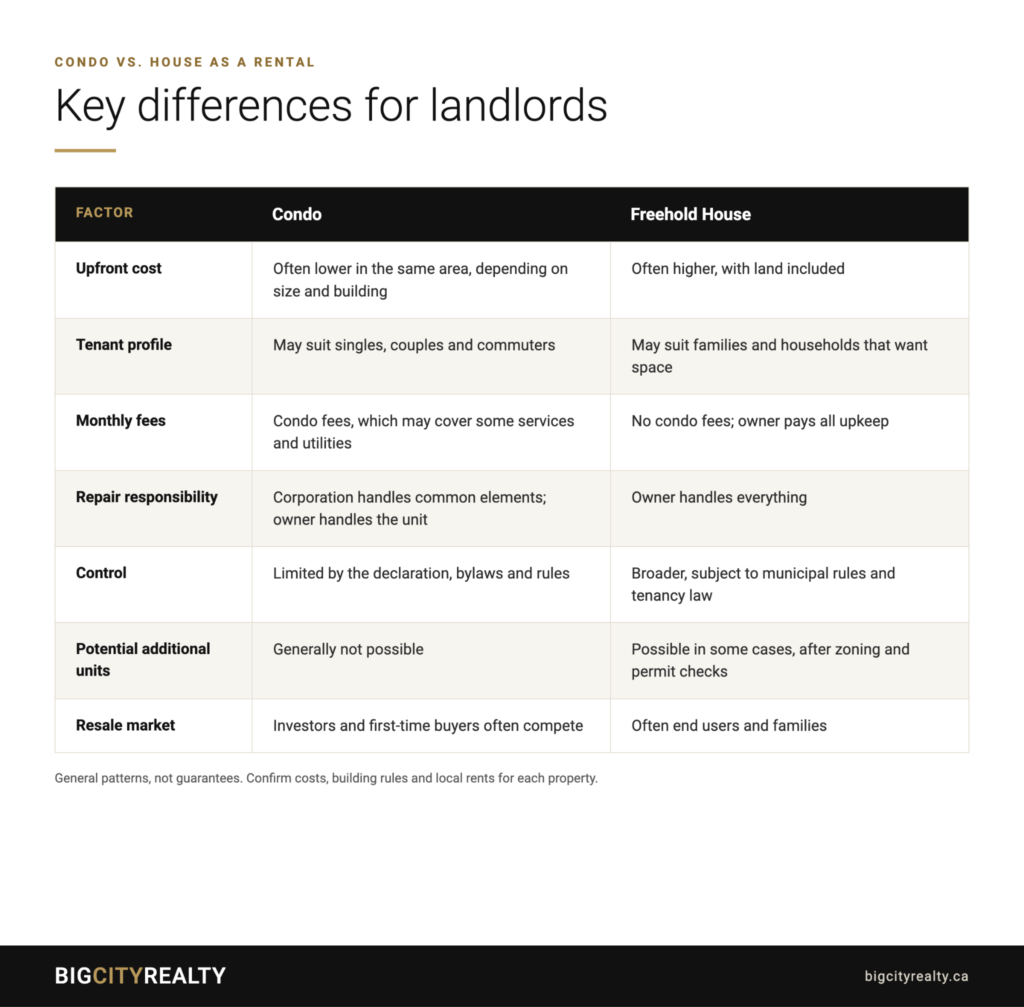
The Short Answer: A condo may suit a landlord who wants a smaller purchase with shared building maintenance. A house may offer more space and control, but with much more repair responsibility. Neither property type guarantees positive cash flow or better returns.
This guide compares a single condo unit with a freehold house, both completed and rented under long-term residential tenancies in the GTA. Short-term rentals and pre-construction purchases are outside the scope here, and additional rental suites are treated as a possibility to verify, not an assumption.
Should I Buy a Condo or a House?
Choosing a condo or house for rental investment starts with five questions: how much capital you have, how you’ll finance it, who your target tenants are, where you want to buy and how willing you are to manage repairs.
Keep two ideas separate. Affordability is whether you can buy the property. Profitability is whether it earns enough after every cost. A cheaper property isn’t automatically the better investment.
Financing also works differently for rentals. Lenders set requirements based on whether you’ll live in the property, the property type and the number of units, and a property you won’t occupy often needs a larger down payment than a home you’ll live in. Don’t assume owner-occupied rules apply. Confirm the details with a lender before you shop.
Many of these trade-offs also shape how buyers choose between a condo or freehold home to live in, so the comparison is useful even if you might move in yourself one day.
Are Condos a Good Investment?

Entry Cost and Rental Appeal
Are condos good rental investments? They can be, mainly because of a lower entry price and strong tenant appeal in the right locations. A condo may cost less than a house in the same area, but actual affordability depends on the suite size, the building, whether parking is included and the location.
Proximity to transit, major employers, campuses and shopping can make a condo easier to rent. Still, not every condo leases quickly. Check recent rentals in the same building and nearby, since a building with many investor-owned units can mean more competition for tenants.
Shared Maintenance and Building Restrictions
The condo corporation maintains the common elements: the roof, exterior, hallways, elevators and amenities. You remain responsible for repairs inside your unit, as defined by the declaration, along with all of your obligations as a landlord. Shared maintenance doesn’t make condo ownership maintenance-free.
Before buying, review the declaration, bylaws and rules for any leasing requirements, such as registering tenants or minimum lease terms. Your lawyer should also review the status certificate for reserve fund health, planned work and special assessments, all of which affect your cash flow. Knowing how to evaluate a condo building before buying is as important for a landlord as for someone moving in, because a weak reserve fund lands on your rental budget.
Is a House a Better Rental Investment?

Space, Control and Tenant Fit
Buying a house to rent out gives you more to offer certain tenants: extra bedrooms, a yard, storage and parking can appeal to families and larger households. The question is whether the rent you can actually achieve justifies the cost of buying and maintaining that space.
You’ll also generally have more control over a freehold property, without a condo board’s rules to follow. That control still sits within municipal requirements, Ontario tenancy law and any agreements tied to the property.
Greater Repair Responsibility
With a house, every repair is yours: the roof, exterior walls, foundation, furnace, air conditioning, water heater, plumbing, landscaping and snow removal, unless your lease assigns some tasks to the tenant. Get a thorough inspection before buying and set aside a realistic reserve for future replacements.
Don’t assume a house will appreciate faster, earn more net income or keep tenants longer than a condo. Each of those depends on the specific property and market, not the property type.
Condo Fees vs. House Expenses
Comparing condo fees versus house expenses only works if you look at the total cost of ownership, not the condo fee alone. For each property, list:
- Mortgage payments
- Property taxes
- Landlord insurance
- Condo fees, if any
- Utilities the owner pays
- Routine repairs and maintenance
- A vacancy allowance
- Property management fees, if you use a manager
Keep Three Types of Costs Apart: Ongoing operating costs, reserves for major replacements and one-time purchase costs such as land transfer tax and legal fees.
A condo fee may already cover services or utilities that a house owner pays separately, such as water, building insurance, snow removal or landscaping. And a house without condo fees still needs money set aside for maintenance.
Avoid Counting the Same Cost Twice: If the corporation already covers building insurance or a utility, don’t add it again. Confirm exactly what’s included, and who’s responsible, for each property you compare.
Rental Income and Cash Flow: Compare the Numbers

Use Local Rental Comparables
Rent estimates should come from recent, similar rentals: same area, bedroom count, condition, parking, utilities and amenities. Asking rents and achieved rents can differ, so lean on signed leases where reliable data exists. Look at how many similar units are listed right now and how long they’ve been on the market, rather than relying on a GTA-wide average.
Good positioning matters too. In Markham, our guide to leasing a condo in Greensborough walks new owners at Joy Station Condos through preparing a suite and bringing it to the local rental market, step by step.
Calculate Cash Flow and Returns Separately
Rental property cash flow in the GTA can look very different once every cost is counted. Here’s a hypothetical side-by-side example. All figures are illustrative, not market averages, and the mortgage payments depend on the down payment and interest rate you assume.
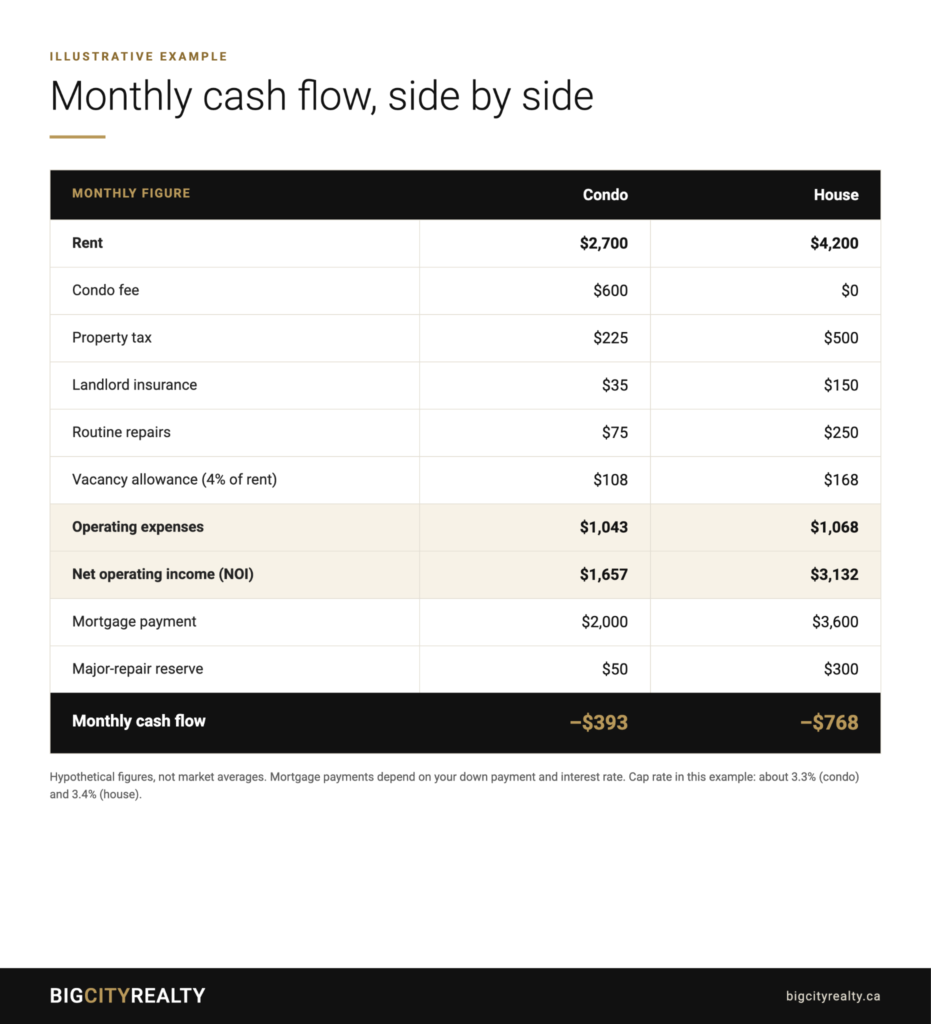
Two terms matter here:
- Net operating income (NOI) is rental income minus operating expenses, before mortgage payments and income tax.
- Cap rate is annual NOI divided by the purchase price.
In this example, the condo’s $19,884 annual NOI on a $600,000 price gives a cap rate of about 3.3%, and the house’s $37,584 on a $1,100,000 price gives about 3.4%.
The major-repair reserve sits outside NOI, so keep it separate and use the same assumptions for both properties. Notice that the house earns more rent and a slightly higher cap rate, yet has weaker monthly cash flow in this scenario. Higher rent or a lower price alone doesn’t make the stronger investment.
If you want to dig deeper into this measure, our explanation of how cap rate works in real estate covers when it’s useful and where it falls short.
Management Workload and Vacancy Risk
Every rental needs active management: answering tenant messages, arranging repairs, preparing the unit between tenancies and handling showings and leases. A condo may reduce the exterior and seasonal work you coordinate, but it doesn’t run itself. A house may mean more contractors, more seasonal tasks and more calls. A property manager can take much of that off your plate, at a cost that belongs in your numbers.
Vacancy is where thin margins get tested. Using the example above, one empty month means losing $2,700 in condo rent or $4,200 in house rent while the mortgage, taxes and other costs keep running. Before buying, make sure your emergency reserve can handle a vacancy and a major repair landing at the same time. Neither property type reliably has lower vacancy or easier tenants; that depends on the property, the price and the local market.
Rental Rules and Additional Suite Potential
Whether Ontario’s annual rent increase guideline applies doesn’t depend on whether you own a condo or a house. It depends on when the unit was first occupied for residential purposes. Units first occupied after November 15, 2018 are generally exempt from the guideline. A recent purchase, a renovation or a new owner doesn’t create an exemption on its own, so check the occupancy history and current Ontario guidance before relying on it.
For houses, a secondary suite can change the numbers significantly, but only once it’s legal. Check zoning, building permits, fire and building code requirements, servicing and your insurance before counting on a second income stream. An unapproved basement apartment isn’t something to build your projections around.
For condos, extra units aren’t usually an option, but leasing requirements are. Confirm what the building requires from owners who rent their suites before you buy.
Long-Term Value and Your Exit Strategy
Think about the sale before you buy. When you eventually sell, the property’s condition, location, carrying costs, and, for a condo, the building’s finances will all shape who’s interested and what they’ll pay.
A condo may attract first-time buyers and other investors, so its value can be sensitive to fees, reserve fund health, and how many similar units are for sale at the same time. A house often draws families and end users, but its condition and any deferred maintenance will show up in offers. Owning land, or having newer amenities, doesn’t guarantee appreciation. Compare recent local sales for similar properties and decide how long you realistically plan to hold.
Which Rental Property Fits Your Landlord Goals?
So, is a condo or house better for landlords? When you compare a condo versus a house as a rental property, the answer depends on your goals:
- You want a manageable entry budget and shared building upkeep. A condo may fit, provided the building’s finances are sound, the leasing rules work for you, and local rents support your numbers.
- You want more space and control, and can fund larger repairs. A house may fit, as long as you’ve budgeted for major replacements, inspected it thoroughly and confirmed that any extra suite is legal.
- You’re focused on cash flow. Run the full numbers for both, using local comparables, every operating cost, your actual financing and a vacancy allowance. Let the numbers decide, not the property type.
Whichever way you lean, check the building or property condition, financing terms, rental comparables, total monthly costs and the legal rules before you commit. Rent, returns and appreciation are never guaranteed in the condo versus house decision.
Compare GTA Rental Properties With Big City Realty
If you’re weighing your next rental purchase, our team at Big City Realty can help you compare suitable GTA properties side by side, from compact condos near transit to houses with room for families.
Our available property listings are a practical starting point, and if you’d rather not take on the day-to-day work yourself, our property management services for landlords can take on much of that work for you. Get in touch to talk through your budget and goals.
Frequently Asked Questions
1. What should I check before buying a rental property with an existing tenant?
Review the current lease, the lawful rent amount, the tenant’s payment history, any rent deposit held and the status of the tenancy. A sale doesn’t end a tenancy automatically; the tenant’s rights generally continue with the new owner. Get legal advice before relying on vacant possession at closing.
2. Can a landlord charge a damage deposit in Ontario?
No. Ontario landlords can collect a rent deposit, generally no more than one month’s rent, which must be applied to the last month of the tenancy, with annual interest owed to the tenant. A refundable key deposit is allowed separately, but neither can be used as a damage deposit for repairs.
3. Do condo and house landlords need Ontario’s standard lease?
In most cases, yes. Ontario’s standard lease generally applies to most private residential tenancies, whether the unit is a condo or a house. Some situations are exempt, such as certain care homes or arrangements where the tenant shares a kitchen or bathroom with the owner.
4. How much notice is needed before entering a rented property?
Generally, at least 24 hours’ written notice, stating the reason and a time between 8 a.m. and 8 p.m. Exceptions include emergencies and situations where the tenant consents to entry. Check the Landlord and Tenant Board’s current guidance before relying on a specific reason for entry.
5. Can a landlord require tenants to carry liability insurance?
Yes, this can generally be added as an additional term in the standard lease. The tenant’s policy covers their own belongings and liability, while your landlord policy covers the property, so keep both in place and don’t assume either covers every loss.