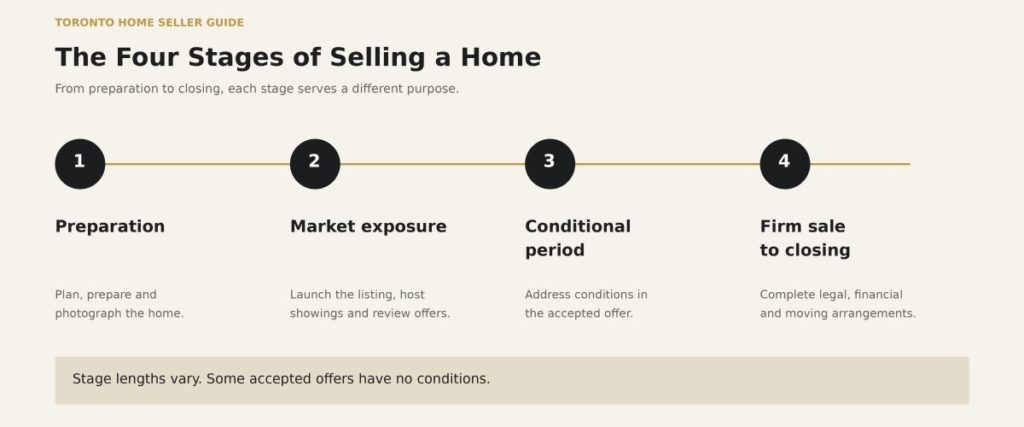
Most sellers ask how long it takes to sell a home in Toronto as if the answer were one number. In practice, it’s four timelines stacked together: getting the home ready, finding a buyer, clearing any conditions, and waiting for the closing date. Only one of them shows up in market reports.
This guide is for Toronto homeowners planning a sale, especially if you’re also buying, relocating, or handling an estate. You’ll see what each stage depends on, how to read days-on-market figures for the Greater Toronto Area (GTA), and how to pick a listing date by working backwards from the day you need to move.
The Selling Timeline Has Four Different Stages
Each stage runs on its own clock, and different people control each one. Breaking the home-selling process into stages shows you which delays you can manage and which ones you can only plan around.
Preparing the Home for Launch
Preparation runs from the day you decide to sell to the day the listing goes live. It usually covers:
- Documents: Survey, property tax bills, utility costs, permits for past renovations, warranties, and, for condos, current fee and corporation details.
- Repairs: Fixes a buyer or inspector would notice right away, scaled to the home’s price point and condition.
- Staging and Cleaning: Decluttering, any furniture changes, and a deep clean.
- Photography and Marketing: Photos, a floor plan, and listing copy, booked once the home looks its best.
A move-in-ready condo might need a week or two, while a detached house with deferred maintenance or an estate full of belongings can need far longer. Start the paperwork early, because listing details should be backed by invoices, receipts, or documentation wherever you can.
From Listing to Accepted and Firm Offer
Once the listing goes live, the clock that market reports measure starts running. This stage has two parts that are easy to blur together:
- Market Exposure: The days between going live and accepting an offer, driven by price, presentation, competition, and season.
- The Conditional Period: If the accepted offer has conditions, the buyer has a set number of days to satisfy or waive them. Until then, the home is sold conditionally, not firmly.
An unconditional offer skips the second part entirely. A conditional one can add days after you thought the hard part was over.
From Firm Sale to Closing and Possession
A firm sale doesn’t mean you hand over the keys that week. The closing date is negotiated in the Agreement of Purchase and Sale (APS), and it can be weeks or months away depending on what you and the buyer need.
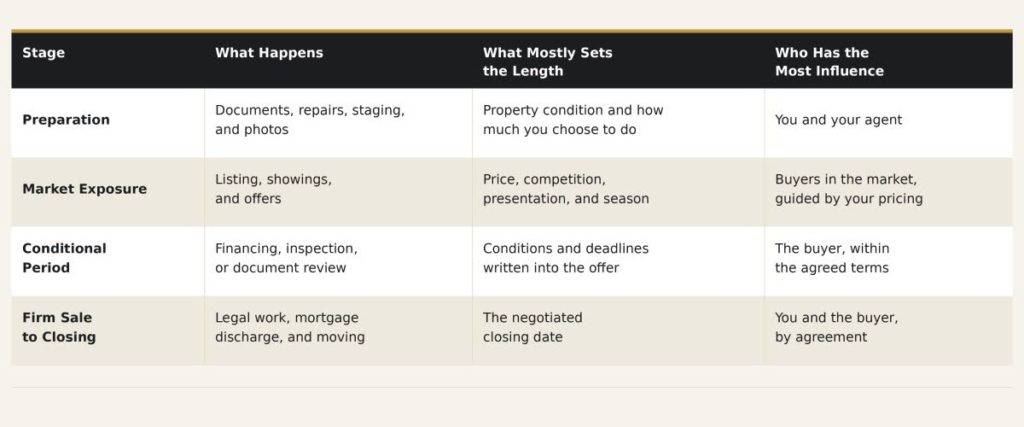
The table below sets the four stages side by side. It leaves out a total on purpose, because each stage varies too much to add up to one honest number.
What Days on Market Actually Measures
Days on market is the figure most sellers latch onto, and it’s useful, but it only covers the market-exposure stage. The Toronto Regional Real Estate Board (TRREB) publishes it every month in its Market Watch report, and two details change how you should read it.
Average vs. Median Selling Time
An average adds up every sale’s days and divides by the number of sales, so a handful of homes that sat for months can pull it up. A median is the middle sale, which is closer to what a typical seller experiences.
TRREB reports days on market as averages (the “Avg.” in its tables), while it gives medians only for prices. Treat the averages as slightly stretched by slow sellers, and ask your agent for the median days of recent comparable sales if you want a tighter planning number.
Listing Days vs. Property Days on Market
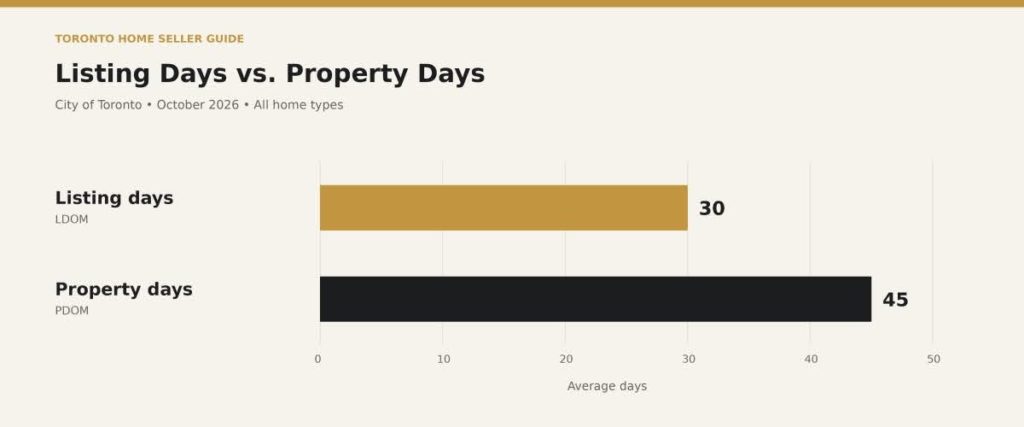
TRREB reports two versions. Listing days on market (LDOM) is the average number of days sold listings were on the market. Property days on market (PDOM) follows the property instead, counting the time across relistings by the same seller and brokerage during the original listing contract.
The gap matters because a home that’s taken off the market and relisted starts a fresh listing clock, while PDOM keeps counting. In the same October 2026 report, GTA homes averaged 31 listing days but 49 property days.
Neither figure includes homes that were withdrawn or expired without selling, and neither covers preparation or closing. They tell you how long sold homes took to reach a firm sale, not how long a sale takes from start to finish.
Use Current Toronto Comparables, Not One GTA Average
A GTA-wide average mixes Oshawa condos with Rosedale detached homes. For a Toronto seller, the useful numbers come from your city, your property type, and your price range.
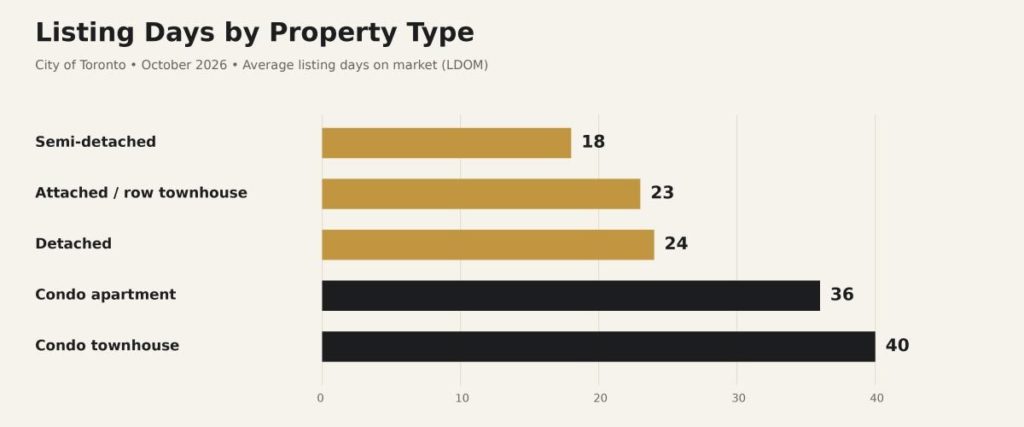
In October 2026, City of Toronto sales averaged 30 listing days and 45 property days on the market, with a median price of $835,000. The pace split sharply by property type, measured in average listing days:
- Semi-Detached: 18 days.
- Attached/Row Townhouse: 23 days.
- Detached: 24 days.
- Condo Apartment: 36 days.
- Condo Townhouse: 40 days.
These are one month’s figures, and TRREB’s tables don’t break days on market out by price band, so treat them as a starting point rather than a forecast. Your agent’s comparables narrow it down: recent sales of similar homes nearby, how long they took, and how many similar listings you’d compete with. It’s the same comparable-sales approach behind a Markham home value analysis, applied to your Toronto street.
How Pricing and Presentation Influence Buyer Response
Price and presentation are the two levers that most affect market exposure, and buyers judge both against whatever else is for sale that week.
Price Against the Homes Buyers Can Choose Today
Buyers compare your home with recent sales, but also with the active listings they toured last weekend. A price that matched last spring’s comparables can still look high if three similar homes are now listed for less.
Pricing against both sold and active competition helps you avoid the slow cycle of price cuts and relists that inflates property days on market. The method, from adjusting for differences between homes to reading the competition, is the same one we use for pricing a home in Markham.
Remove Avoidable Presentation and Access Friction
Presentation won’t rescue an overpriced home, but friction can slow down a well-priced one. Focus on:
- Accurate Photos: Bright, honest photos and a floor plan help the right buyers book showings, while photos that oversell bring in disappointed visitors.
- Proportionate Repairs: Fix what an inspection would flag or what buyers notice at the door, without renovating to someone else’s taste.
- Showing Access: Wide booking windows and a home that’s ready on short notice mean more buyers actually get through the door.
None of these guarantees a faster sale. They remove reasons for a buyer to pass before seeing the home properly.

Showings, Offer Strategy, and Property-Specific Friction
Some homes take longer for reasons that have little to do with price. These are the ones to plan for:
- Occupancy: Tenant-occupied homes come with notice rules and tenant schedules, and a busy family home may have fewer showing windows. Vacant homes are easier to show, but moving out early isn’t right for every seller or budget.
- Condo Documents: Buyers often make offers conditional on reviewing the status certificate, and the condo corporation has up to 10 days to provide it. Ordering one before you list removes that wait.
- Unusual Features: A heritage designation, an unpermitted basement unit, or a shared driveway can mean extra questions from buyers, lenders, and lawyers.
- Offer Strategy: Holding offers until a set date can draw competition in some segments and stall in others. Base the choice on current activity for homes like yours, not on habit.
Conditional Offers and the Route to a Firm Sale
A conditional offer can still be a good offer, but it isn’t a finished sale. The conditions you’ll see most often are:
- Financing: The buyer confirms mortgage approval, which can include the lender’s own appraisal.
- Home Inspection: The buyer has the home inspected and decides whether they’re satisfied.
- Document Review: For condos, the buyer’s lawyer reviews the status certificate package.
Each condition has its own deadline in the APS, and the buyer either waives it or the deal ends according to its terms. The mechanics of conditional sales in Ontario, including what happens when a buyer can’t satisfy a condition, are worth knowing before you accept one. Until the last condition is waived, plan your next purchase as if this sale could still fall through.
How Much Time to Allow Between Firm Sale and Closing
There’s no standard gap. The closing date is whatever you and the buyer agree to in the APS, and it’s usually shaped by both sides’ next moves. Several things need to fit inside it:
- Mortgage Discharge: If you have a mortgage, your lawyer requests a payout statement from your lender setting out what’s needed to discharge it, and the balance is paid out of the sale proceeds.
- Title Work: The buyer’s lawyer searches title and raises any issues with your lawyer before closing.
- Moving: Booking movers, arranging storage, and lining up your next home, ideally with a cushion in case dates shift.
On closing day, the lawyers oversee the transfer of funds and keys. Your lawyer confirms what your transaction requires and when, so bring them in as soon as the sale is firm.

Build a Timeline Around Your Next Move
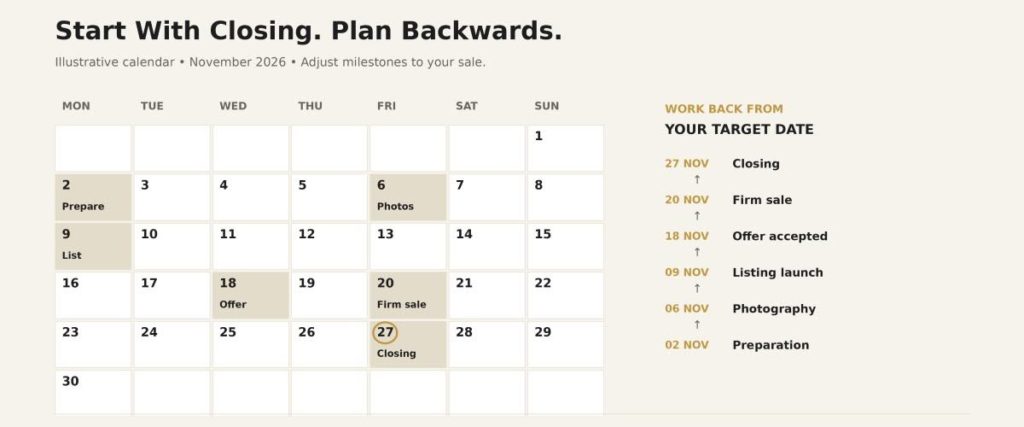
The most dependable answer to how long it takes to sell a home in Toronto comes from starting with the date you need to be out and working backwards. The dates below are illustrative, chosen only to show the method:
- Target Closing: You want to close on July 30, 2027, to line up with your next home.
- Firm Sale By: If you’re comfortable offering a 60-day closing, you’d want a firm deal by about May 31.
- Accepted Offer By: Allowing a week for conditions moves that to around May 24.
- Listing Date: Planning around Toronto’s recent 45 property days, rather than the 30 listing days, builds in room for a slow start, so you’d list by about April 9.
- Start Preparing: Three to four weeks of preparation puts your start in mid-March.
Build in a contingency for dates that don’t line up, and factor Ontario realtor fees, legal costs, and moving into what you’ll net. Then swap in your own property type, current comparables, and preferred closing period, and the plan adjusts to your situation.
When you’re ready to put real numbers on it, selling your home with Big City Realty starts with your property, your comparables, and the date you need to move, so the listing plan is built around your next step rather than a market average.
Frequently Asked Questions
1. Can I accept an offer while I am travelling outside Canada?
Often, yes, with planning. Offers are commonly signed electronically, but you’ll need reliable contact and a plan for irrevocable deadlines across time zones. Ask your lawyer early which closing documents can be signed remotely and what ID verification, witnessing, or power of attorney your deal needs, since requirements vary.
2. Does the buyer receive the keys as soon as an offer becomes firm?
No. A firm offer makes the deal binding, but the buyer normally gets the keys on the closing date, once the lawyers have completed the transfer and the funds have moved. Earlier access, such as a pre-closing visit or early possession, happens only if the APS allows it or you both agree in writing.
3. Can an estate sale take longer even after a buyer is found?
It can. Whoever signs for the estate needs legal authority to sell, and in some cases that means waiting on court confirmation, such as a Certificate of Appointment of Estate Trustee, before closing. The estate lawyer can tell you what your case requires and what closing date you can safely offer.