Two condos in the same GTA neighbourhood can carry similar price tags and still be very different purchases. One is a finished suite you buy from its owner and move into on a date you both agree on. The other is a contract to buy a unit the builder hasn’t finished yet, with deposits to reimburse, builder approval to secure and a closing date that depends on construction.
That’s the real question behind assignment sale vs. resale. You’re not only choosing a home. You’re choosing a contract, a cash timeline and a set of risks that look quite different on each side.
The Short Answer: In an assignment sale, you take over another buyer’s agreement to purchase a property from a builder, usually before the building is complete. In a resale, you buy a finished property directly from its current owner. Assignments often call for more cash up front and the builder’s consent, while resales follow the standard offer-and-closing process on a date you negotiate.
What Is an Assignment Sale?
So, what is an assignment sale in Ontario? It starts with an Agreement of Purchase and Sale (APS) signed between a builder and an original buyer, usually while the project is still under construction. Before that buyer closes, they sell their position in the contract to someone else.
Three terms come up in every assignment:
- Assignor: The original buyer who signed the APS with the builder and is now selling their position.
- Assignee: The new buyer who takes over that position.
- Original APS: The builder contract, including any amendments, that sets out the price, deposit schedule, closing terms and buyer obligations.
As the assignee, you generally step into the original purchaser’s shoes, subject to the terms of the agreement and any approvals the builder requires. You don’t own the property when the assignment completes. Ownership transfers separately, at final closing, when the builder registers the building and title passes to you.
Assignment opportunities can come up before completion or, if the contract allows it, during interim occupancy. Don’t assume either window is open. Many builders require written consent, charge an assignment fee or limit how and when an assignment can be marketed, and some don’t allow assignments at all. If you’re looking in York Region, the way these rules play out locally is worth seeing through assignment sales in Markham, where both buyers and sellers deal with the same consent and timing questions.
What Is a Resale Property?
A resale is a property you buy from its current owner, with ownership transferring to you on the closing date written into your agreement. You can view the home before you offer, and your offer can include conditions such as financing, a home inspection or a review of the condo’s status certificate. Once conditions are met and the deal firms up, your lawyer handles the title search, funds and registration on closing day.
If you’ve looked into how to buy a home in Ontario, this path will feel familiar: get pre-approved, compare properties, make an offer, firm it up and close.
Resale doesn’t mean old. A resale condo in the GTA could be a suite in a 1980s building or one completed two years ago and now sold by its first owner. The word describes how you’re buying, not the age of the building.
Assignment Sale vs. Resale: Key Differences
The clearest difference between assignment sale and resale purchases is what you actually acquire: a contractual position in one case, a finished property in the other. Everything else flows from that.
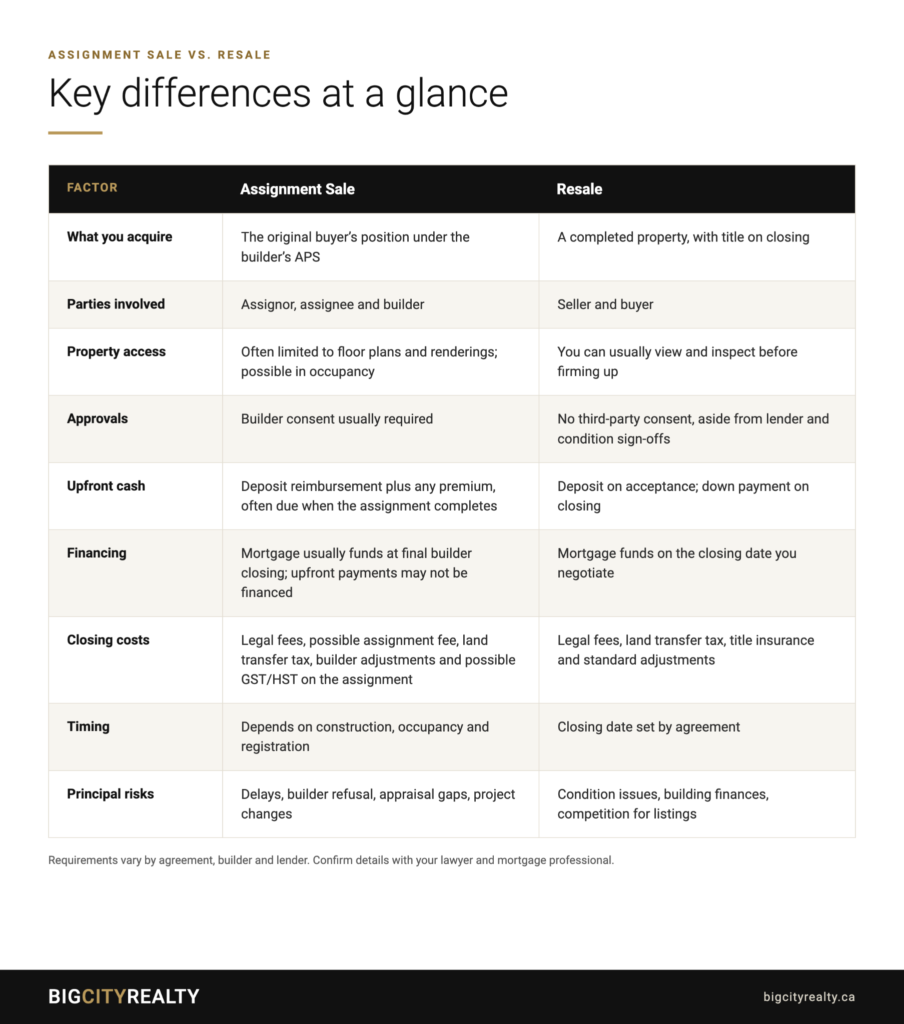
Buying a new unit directly from a builder is a third route. In that case, you sign the original APS yourself and follow the builder’s deposit schedule from day one. The trade-offs of that choice sit within the wider debate over pre-construction versus resale properties. This article stays focused on taking over someone else’s contract versus buying from an owner.
Deposits, Financing and Closing Costs

In most assignments, you reimburse the assignor for the deposits they’ve already paid to the builder, plus any premium you negotiate. If the market has softened, the agreed price could also be below what the original buyer paid, so the payment to the assignor can be smaller. On top of that, you may owe further builder deposits still due under the original schedule, an assignment or consent fee if the builder passes it on, and your own legal costs. When each amount is due depends on the assignment agreement and the builder’s consent terms.
Here’s an illustrative example:
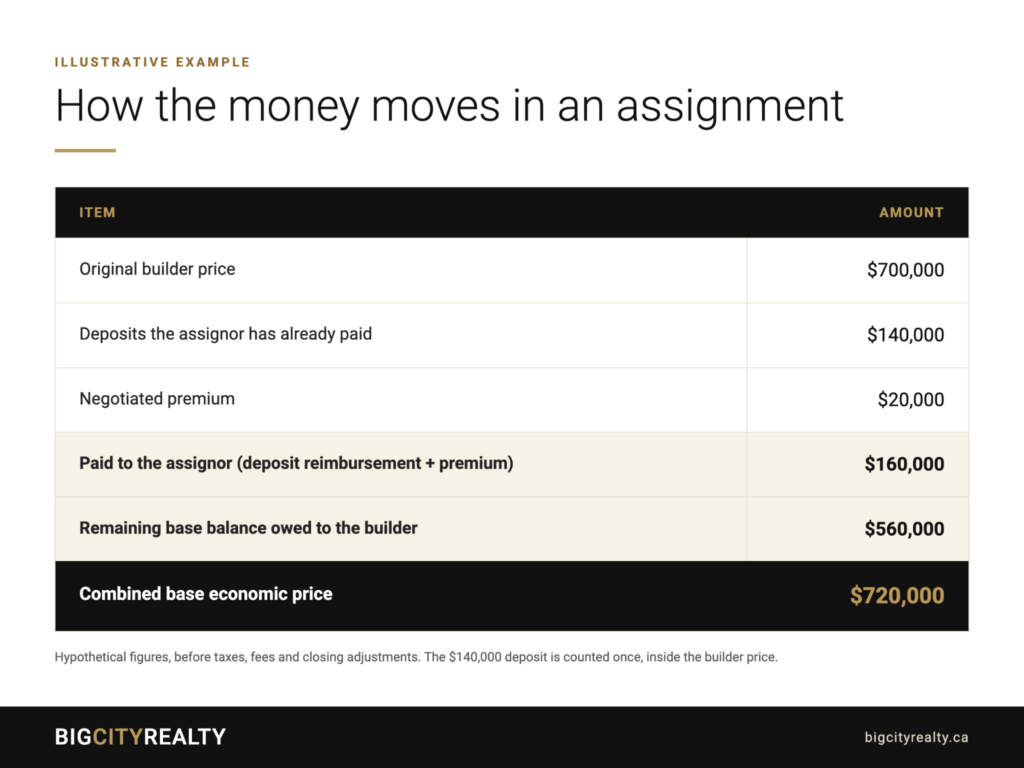
The $140,000 deposit is counted once. It’s part of the $700,000 builder price, which is why the remaining balance is $560,000, not $700,000. The $720,000 total is before taxes, fees and closing adjustments. And $160,000 isn’t a universal amount you’ll need on day one; the actual timing and figures depend on your agreement.
Can You Get a Mortgage for an Assignment Sale?
Often, yes, but the details need confirming early. Your mortgage typically funds at final closing, when you pay the builder the remaining balance. Lenders will look at the property’s appraised value at that point, and a lender may not finance the deposit reimbursement or premium you pay the assignor up front. Those amounts usually come from your own funds.
A pre-approval is useful, but it doesn’t guarantee financing for an assignment or for the final closing, which may be months or years away. Knowing the difference between mortgage pre-approval versus pre-qualification helps you judge how much weight your current approval can actually carry, and when to ask your lender to confirm it will accept an assignment.
Which Closing Costs and Taxes Should You Check?
Both routes involve legal fees, land transfer tax, title insurance and adjustments. Assignment sale closing costs in Ontario aren’t automatically lower, though. They can also include:
- An assignment or consent fee charged by the builder
- Builder closing adjustments, which may include development charges or levies, utility connection fees and warranty enrolment fees, depending on the APS
- Land transfer tax at final closing, generally based on the total consideration, which can include the premium you paid
- GST/HST on the assignment itself
On that last point, assignment sales of newly built residential properties have generally been taxable for GST/HST since May 2022. That tax applies to the assignment, which is separate from the tax on the builder’s original sale. Under current CRA rules, the portion of the payment that reimburses the original deposit is generally excluded from the taxable amount, so the tax usually falls on the premium. Your assignment agreement should state clearly whether the price includes this tax.
New-home rebates also changed in 2025 and 2026, at both the federal and provincial level. For assignments, eligibility can depend on when the original APS was signed, not only when you took it over. Confirm deposit treatment and any rebate eligibility with your lawyer or tax adviser before you sign.
Occupancy and Closing Timelines
An assignment can involve three separate milestones, and it helps to keep them apart:
- Assignment Completion: The date you formally take over the original buyer’s position.
- Interim Occupancy: In a condo, the period when you can move in before the building is registered. You pay a monthly occupancy fee, which generally covers interest on the unpaid balance, estimated common expenses and property taxes. It’s not a mortgage payment, and it doesn’t reduce your purchase price. Interim occupancy also doesn’t transfer title.
- Final Closing: Once the condominium is registered, title moves from the builder to you and your mortgage funds.
The gap between these steps is what makes a contract-based purchase different, and it’s the part of how pre-construction condos work in Ontario that most often catches assignees off guard. Construction delays, extended occupancy dates and registration timing can all move your final closing.
A resale, by contrast, closes on a date you negotiate with the seller. Still, neither route is fixed. Some assignments are taken over close to occupancy, so the wait can be short. And a resale isn’t always available for immediate move-in, especially if the seller needs a longer closing or a tenant is in place.
Risks and Due Diligence Before You Buy

Assignment Documents to Review
If you’re buying an assignment condo, ask your lawyer to review the full paper trail before you commit:
- The original APS and every amendment
- The assignment agreement
- The builder’s written consent and its conditions
- Receipts for every deposit already paid
- The remaining deposit schedule, fees and expected closing adjustments
- Any conditions still outstanding, and the current occupancy status
Confirm exactly which obligations you’re taking on, and how deposits would be handled if the project doesn’t go ahead. In some assignments, the original buyer remains on the hook alongside you, so it’s worth knowing where responsibility sits.
Resale Property and Condo Checks
Resale due diligence focuses on the property itself. An inspection condition, a title review and a financing condition protect you while you check the details. For condos, your lawyer should review a current status certificate, which shows the reserve fund, any special assessments, maintenance fees and the building’s rules.
Physical condition matters too: elevators, windows, the garage and common areas tell you a lot about how a building has been run. Knowing how to evaluate a condo building before buying is what separates a suite that looks great from a building that’s well funded, and both matter for a resale condo.
Which Option Fits Your Buying Plans?
There’s no universal winner in the assignment sale versus resale debate. The better route is the one whose cash needs, timing, and risks fit your situation. Here’s how that plays out for three common buyers.
- You have a firm moving deadline. A lease ending or a job starting on a set date makes timing your biggest risk. A resale with a negotiated closing gives you more control. If you’re considering an assignment, check how close the project is to occupancy and how much room the builder still has to extend dates.
- You want a newer unit, and your timing is flexible. An assignment can give you access to a new building, sometimes in a sold-out project. Compare the total price, including the premium, with similar completed units nearby, and make sure you’re comfortable with possible delays.
- Your cash is limited before financing kicks in. Assignments can require a large payment to the assignor long before your mortgage funds, while a resale typically asks for a deposit up front and the rest of your down payment on closing. Map out exactly when each payment is due under both options.
Whichever route you’re leaning toward, compare total cost against recent sales of comparable local properties. Nobody can promise a discount, future appreciation or a return on either path. It also helps to keep the transaction separate from the property itself: if you’re still deciding between a condo or freehold home, settle that first, then choose how you’ll buy it.
Compare Your GTA Buying Options With Big City Realty
Weighing an assignment sale vs. resale in Ontario is easier when you can see real options side by side. Share your budget, preferred location and moving timeline with Big City Realty, and our team will help you compare suitable opportunities, whether that’s an assignment sale in the GTA or a finished home you can view this week.
We can also help coordinate the legal and financing reviews that keep each step on track. Start by browsing pre-construction homes and condos across the region, or look through our available property listings and ask us which ones are assignments, resales or new releases.
Frequently Asked Questions
1. Can an assignment sale take place after interim occupancy begins?
Sometimes. It depends on the APS and the builder’s policy. Some builders allow assignments during occupancy with consent, while others restrict them once occupancy starts. If it’s permitted, the assignee usually takes over the occupancy fee obligations as well.
2. What happens if the builder refuses assignment consent?
If the APS requires consent and the builder refuses, the assignment generally can’t go ahead. That’s why the assignment agreement should be conditional on builder approval, with clear terms on how your deposit is returned if consent isn’t granted.
3. Does reimbursing the original deposit count toward my purchase?
Yes. The deposit the assignor paid stays credited against the builder price, so reimbursing it effectively makes it your deposit. You then owe the builder the remaining balance, not the full original price.
4. Can I negotiate an assignment price below the original builder price?
You can, if the assignor agrees. In that case, the assignor may receive less than they paid in deposits. Some builders set their own rules on assignment pricing, so check the APS before negotiating.
5. Can a first-time buyer purchase an assignment property?
Yes, as long as you can meet the cash and financing requirements. First-time buyer rebates and land transfer tax refunds have specific eligibility rules, and for new homes some depend on when the original APS was signed. Check the current program rules with your lawyer before counting on any rebate.
6. What happens if the appraisal is lower than the total assignment purchase cost?
Your lender will generally lend based on the lower appraised value, so you’d need to cover the shortfall with your own funds at closing. Discuss this risk with your mortgage professional before you commit, especially if you’re paying a premium.